
Why Outcomes Intelligence Is Having Its Moment — and What PatientIQ Is Building Next
PatientIQ secures $30 million in funding to advance outcomes intelligence, bridging the gap in healthcare data collection and enhancing patient care.
3 min read

There is no shortage of confidence in what artificial intelligence will do for healthcare. The predictions are sweeping: AI will flag deteriorating patients before clinicians notice the signs. It will predict readmissions, recommend treatment adjustments, and personalize care at a scale no individual provider could achieve alone.
Some of that is already happening. But there is a foundational problem that most of the AI conversation glosses over: the quality of any AI system's output is limited by the quality of the data it was trained on and the quality of the ongoing data it receives.
And in healthcare, a substantial share of the most clinically relevant data is missing from most AI systems entirely.
The electronic health record is the primary data source for most healthcare AI applications. It contains a rich record of clinical encounters: diagnoses, procedures, lab results, imaging findings, medication orders, vital signs. It captures what happened during a visit. It captures what a clinician documented.
What it does not capture reliably is how a patient is actually doing.
How much pain are they in on a typical day? Has their ability to walk a quarter mile changed since their last visit? Are they experiencing fatigue that limits their ability to work? Do they feel that their care is helping? Are they satisfied with their functional recovery three months after surgery?
These questions (the ones patients themselves can answer and clinicians cannot directly observe) are the domain of patient-reported outcomes (PROs). And they represent a dimension of clinical reality that most healthcare AI systems have no access to.
Consider a predictive readmission model trained on EHR data. It can identify patients with the clinical characteristics that historically correlate with readmission: certain diagnoses, prior hospitalizations, specific lab value patterns. It is a useful tool.
But it cannot see that a patient discharged after a joint replacement is struggling to perform basic daily activities and falling behind on their home exercise program. It cannot detect the early functional decline that precedes a complication or an ED visit. That signal lives in the patient's own experience, and without a structured way to capture it, it never enters the model.
The same gap exists across clinical AI use cases. Models that predict surgical outcomes are trained on what happened in the OR and what the EHR recorded. They are not trained on what patients reported about their recovery trajectory. Models that flag chronic disease deterioration have access to labs and vitals. They typically do not have access to validated symptom burden or quality-of-life measures.
The result is a version of clinical AI that is genuinely useful within the limits of what it can see, but blind to a dimension of patient experience that is highly predictive and clinically actionable.
One reason PRO data has been slow to make its way into AI systems is the perception that it is hard to collect at scale and difficult to standardize. That perception is outdated.
PatientIQ automates delivery and capture across large patient populations, integrated directly into EHR workflows. A patient scheduled for a spine surgery is automatically enrolled in the appropriate care pathway, receives outcome surveys via text or email, and completes them on their phone. Results are structured, timestamped, and attached to the patient record.
PatientIQ automates delivery and capture across large patient populations, integrated directly into EHR workflows. A patient scheduled for a spine surgery is automatically enrolled in the appropriate care pathway, receives outcome surveys via text or email, and completes them on their phone. Results are structured, timestamped, and attached to the patient record.
Our programs achieve 94%+ collection rates via automated patient engagement. The data is not a trickle—it is a stream. And because it uses validated instruments with standardized scoring, it is comparable across patients, providers, sites, and time.
That is exactly the kind of data AI systems need: structured, longitudinal, and generated at the point of patient experience rather than reconstructed from administrative codes.
When patient-reported outcomes are collected systematically and integrated into a health system's data infrastructure, the picture available to both clinicians and AI systems changes substantially.
Predictive models can incorporate trajectory data, not just where a patient is today, but how their self-reported functional status has changed over time. Early warning systems can detect patterns that precede deterioration before they show up in clinical measures. Benchmarking becomes more meaningful because outcomes comparisons reflect what patients actually experienced, not just what was billed or documented.
At PatientIQ, more than 50 million patient outcomes have been collected across 850 healthcare organizations and 12,000 sites of care. That data — structured, validated, and longitudinal — represents exactly the kind of patient-experience signal that makes clinical data more complete and more useful for the analytical applications health systems are now building.
Healthcare organizations investing in AI and analytics infrastructure often focus first on EHR data integration, claims data, and imaging pipelines. Those are the right starting points. But the organizations that will get the most out of their AI investments over the next five years will be the ones that also have a systematic, automated approach to capturing what their patients are reporting.
Building that capability does not require a separate initiative. The most effective PRO programs are embedded in clinical workflows, triggered automatically at the point of scheduling, and integrated with the same EHR systems that feed downstream analytics and AI applications.
The data exists. The patients are willing to share it. The technology to collect it at scale is available. What most health systems are still missing is the decision to treat patient-reported outcomes as a core data asset rather than a compliance requirement or a quality initiative afterthought.
AI in healthcare will keep improving. The systems that feed it the best data will see the best results.

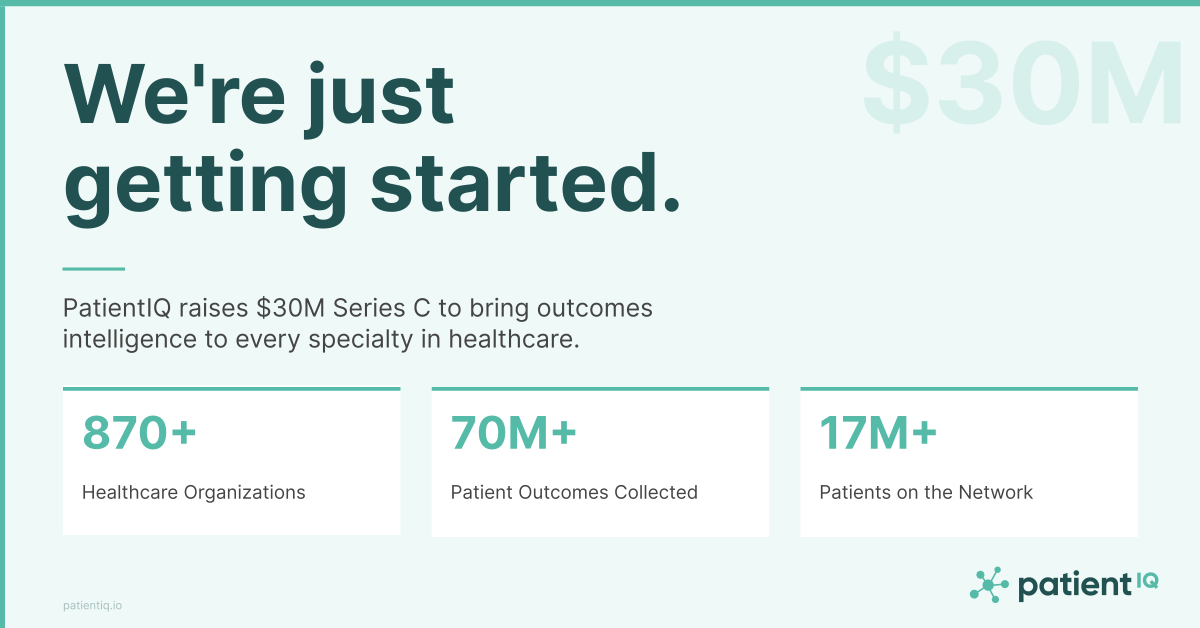
PatientIQ secures $30 million in funding to advance outcomes intelligence, bridging the gap in healthcare data collection and enhancing patient care.
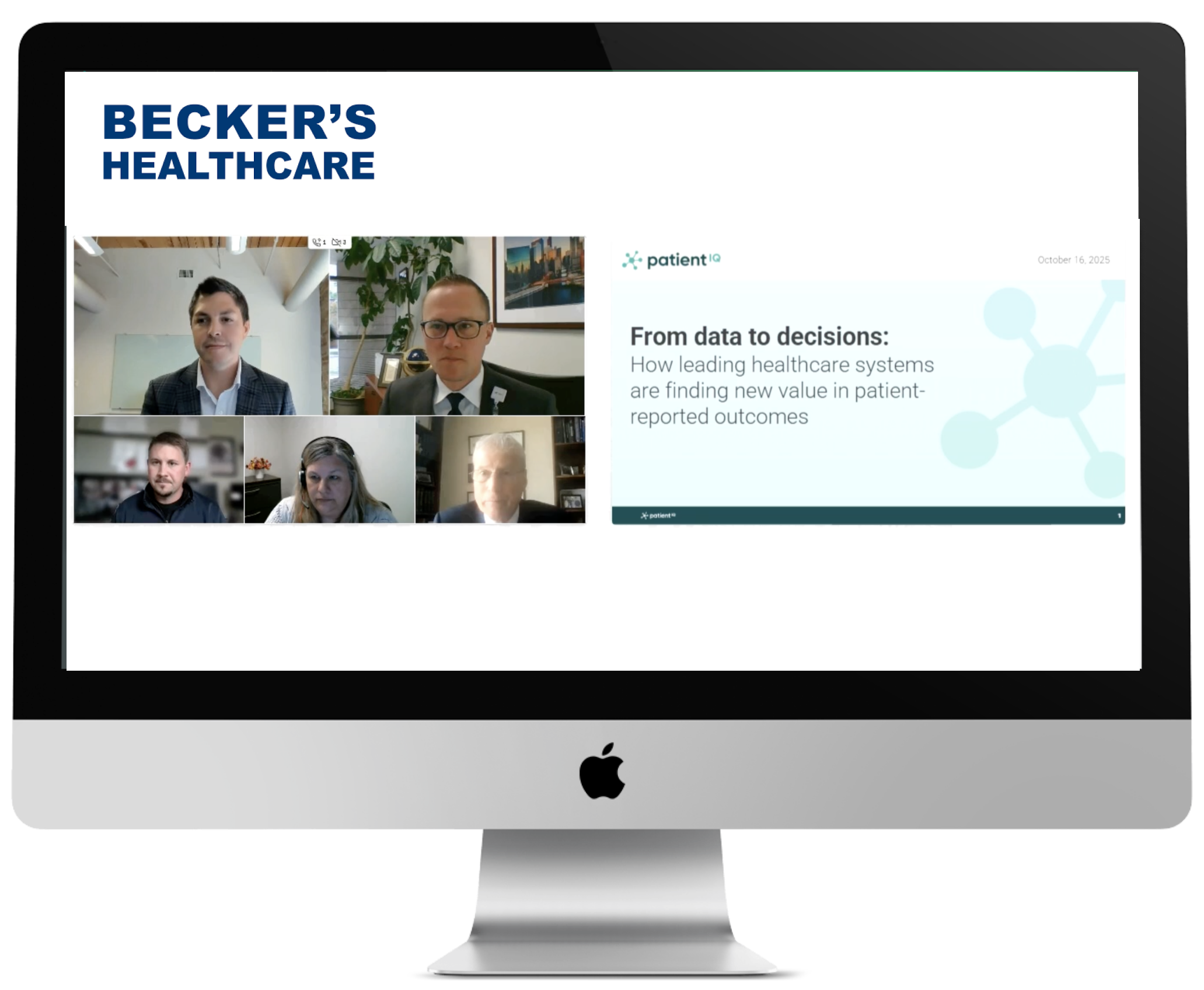
Explore key insights from PatientIQ’s Becker’s Healthcare webinar on how leading systems find new value in patient-reported outcomes.
.png)
Explore the importance of patient-reported outcomes in neurosurgery and how advanced measurement tools can enhance patient care and recovery tracking.